
Introduction
When importing or distributing matches, one of the most common questions buyers ask is about Cardboard vs Wooden Safety Matches. Choosing the right type of safety matches can make a significant difference in product performance, customer satisfaction, and profitability.
Safety matches remain an essential household product across many regions, particularly in Africa, the Middle East, and parts of Asia. They are widely used for lighting stoves, candles, and household appliances. Because of this high demand, distributors must carefully select the most suitable match type for their specific market conditions.
Understanding the differences between Cardboard vs Wooden Safety Matches helps importers make informed purchasing decisions. Each type offers unique advantages depending on climate, price sensitivity, retail distribution, and consumer preferences.
In this guide, we will compare cardboard and wooden safety matches in detail to help you determine which option is best for your market.
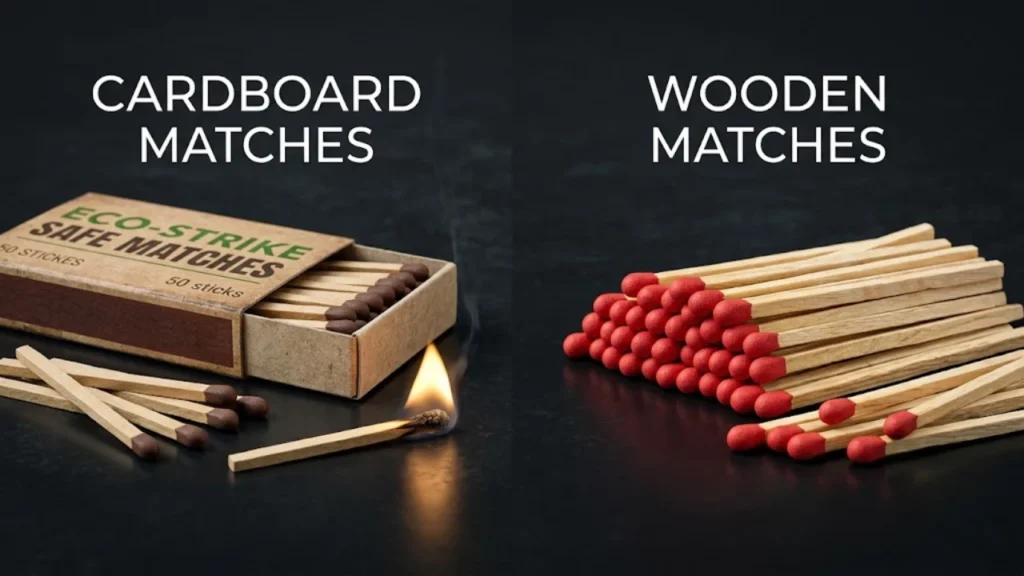
Understanding Cardboard Safety Matches
- Cardboard safety matches are one of the most widely used match products in many countries. These matches are typically packed in lightweight cardboard boxes and contain splints made from compressed cardboard material.
- One of the biggest advantages of cardboard matches is their affordability. Because they are made from processed cardboard rather than natural wood, they can be produced in large quantities at a lower cost. This makes them an attractive choice for wholesalers and distributors targeting price-sensitive markets.
- Cardboard safety matches are commonly used for everyday household purposes such as lighting stoves, candles, and incense sticks. They are easy to carry, compact, and widely distributed through supermarkets, convenience stores, and small retail outlets.
- Another reason for their popularity is the simplicity of packaging. Cardboard matchboxes can easily include printed labels and branding, allowing distributors to promote their own brand in retail markets.
Understanding Wooden Safety Matches
- Wooden safety matches are another popular option in international markets. Unlike cardboard matches, these are made from thin wooden splints, usually sourced from softwoods such as poplar or aspen.
- One of the key advantages of wooden matches is their durability and longer burn time. Wooden splints burn more steadily and can produce a stronger flame compared to cardboard matches. Because of this, they are often preferred in situations where a longer burn is required.
- Wooden safety matches are commonly used in restaurants, hotels, outdoor environments, and households that prefer stronger matchsticks. They are also popular in markets with higher humidity levels because wooden splints tend to maintain their structure better than cardboard when exposed to moisture.
- For premium retail markets, wooden matches are often packaged in veneer or high-quality cardboard boxes with attractive branding.
Cardboard vs Wooden Safety Matches: Key Differences
When comparing Cardboard vs Wooden Safety Matches, several factors should be considered.
1. Cost and Affordability
- Cardboard matches are generally more affordable because the raw materials are cheaper and production is highly efficient. This makes them ideal for mass retail markets where consumers look for low-cost everyday products.
- Wooden matches, on the other hand, tend to be slightly more expensive due to the cost of wood materials and additional processing. However, they often provide better durability and performance.
- For distributors targeting high-volume sales in price-sensitive regions, cardboard matches may be the more practical choice.
2. Burn Time and Performance
- Another important difference in Cardboard vs Wooden Safety Matches is burn time.
- Wooden matches usually burn longer and produce a stronger flame. This makes them suitable for lighting candles, cooking stoves, fireplaces, or outdoor applications.
- Cardboard matches burn slightly faster but are still effective for everyday household tasks.
- If your market prefers matches with extended burn time, wooden matches may be the better option.
3. Climate and Weather Conditions
- Climate plays a significant role when choosing between Cardboard vs Wooden Safety Matches.
- In humid or tropical regions, moisture can affect match performance. Wooden matches often perform better in these conditions because the wooden splints maintain their structure even when exposed to humidity.
- Cardboard matches can still perform well if they are properly packaged and stored in moisture-resistant boxes.
- Distributors supplying coastal or high-humidity regions may find wooden matches to be more reliable.
4. Packaging and Branding Opportunities
- Cardboard matches offer excellent opportunities for branding and customization. The outer matchbox surface provides space for printed labels, logos, and product information.
- This makes cardboard matches popular among distributors who want to promote their own brand through private labeling.
- Wooden matches can also be branded, but the packaging options are usually slightly more premium and may involve additional costs.
5. Market Preferences
- Different regions often show different preferences when it comes to Cardboard vs Wooden Safety Matches.
- In many African countries, cardboard matches are widely distributed through retail stores because they are affordable and suitable for everyday use.
- However, wooden matches are often preferred in markets where consumers value durability and longer burning matchsticks.
- Understanding local market behavior can help importers select the right product type.
Which Safety Matches Are Best for African and Middle Eastern Markets?
- When comparing Cardboard vs Wooden Safety Matches for African and Middle Eastern markets, both options have strong demand depending on the target customer base.
- Cardboard matches are commonly sold in supermarkets and retail shops due to their low price and easy distribution.
- Wooden matches, however, are frequently used in hospitality sectors, restaurants, and premium retail markets where stronger matchsticks are preferred.
- In some regions, distributors even import both types to serve different customer segments.
How Importers Choose the Right Match Type
Importers evaluating Cardboard vs Wooden Safety Matches should consider several important factors before making a decision:
Target retail market or distribution network
Climate and humidity levels in the region
Consumer price sensitivity
Packaging and branding requirements
Burn time expectations for customers
By analyzing these factors, distributors can select the match type that best meets local market demand.
The Role of Indian Manufacturers in Safety Match Exports
- India is one of the world’s leading producers of safety matches, supplying both cardboard and wooden matches to international markets.
- Manufacturing regions in southern India have decades of experience producing matches for export. These manufacturers combine traditional expertise with modern machinery to ensure consistent quality.
- Because of this strong manufacturing base, many international buyers rely on Indian exporters for both cardboard and wooden safety matches.
Conclusion
The comparison between Cardboard vs Wooden Safety Matches ultimately depends on the needs of your market. Both products offer unique advantages that can benefit distributors and retailers.
Cardboard matches are affordable, lightweight, and ideal for high-volume retail markets. Wooden matches provide longer burn time, stronger splints, and improved performance in humid environments.
For importers and wholesalers, understanding the differences between these two types helps ensure that the right product reaches the right customers.
By carefully evaluating market demand, climate conditions, and pricing strategies, distributors can choose the best option between Cardboard vs Wooden Safety Matches and build a successful supply chain for this essential household product.